

Gate Hardware for Wood Gates
Gate hardware for wood gates plays an important role in building a strong, reliable wood gate. This guide covers the most common hardware used for wood gates, including strap hinges, T-hinges, heavy-duty gate hinges, latches, gate wheels, handles, fasteners, and double-gate hardware. Learn how each type of hardware works, where it is best used, and what to consider when choosing hardware for your gate.
Choosing the Right Gate Hinge
Gate hinges connect the gate to the supporting post and allow it to open and close while carrying the weight of the gate. Choosing the right hinge depends on several factors, including the gate’s size, weight, construction, mounting style, and swing direction. Common choices include GFORCE Hinges, Infinity Hinges, T-hinges, and strap hinges, each with advantages and limitations depending on the application. Use our Wood Gate Hinge Comparison to compare these hinge types and determine which option best fits your gate.
T-Hinges
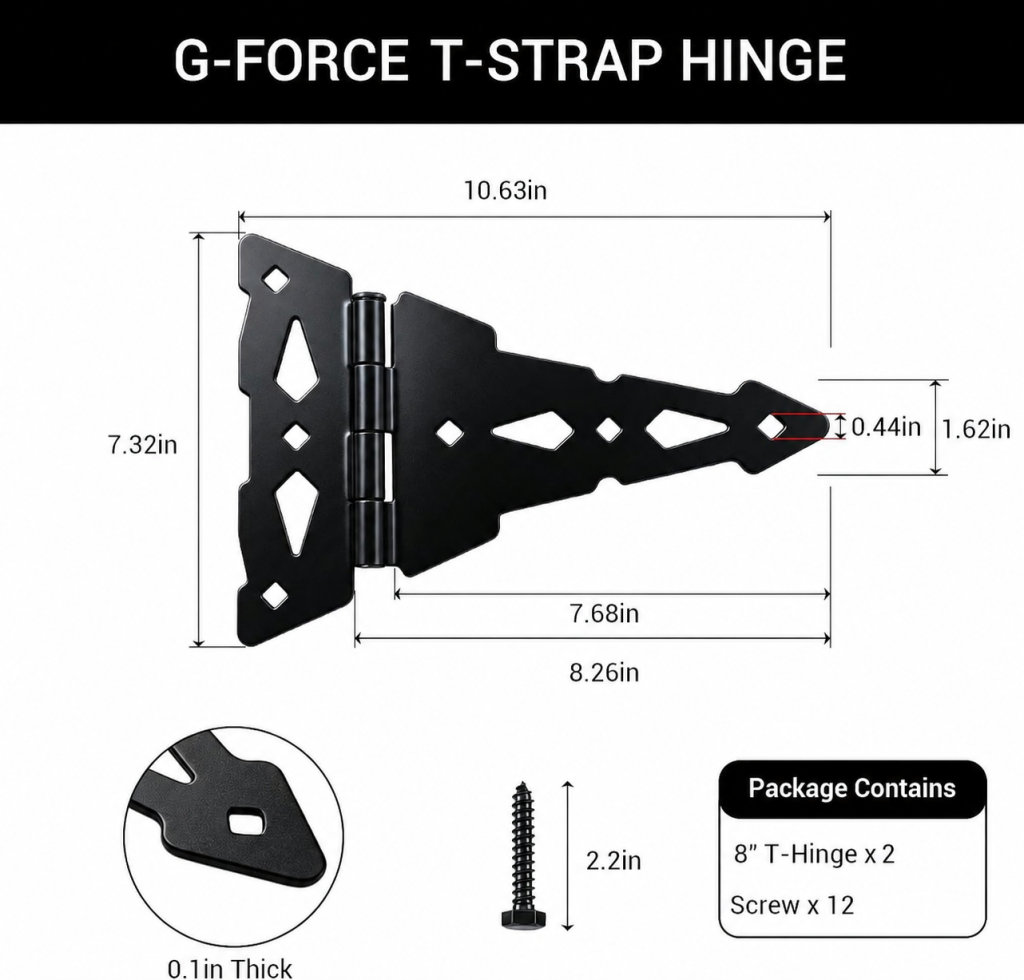
T-hinges are especially useful when a wood gate needs to swing inward while keeping the finished fence-board side facing outward. The short mounting plate of the T-hinge attaches to the side of the hinge post, while the longer strap attaches across the horizontal rail of the gate. This positions the hinge pin so the gate can swing inward without requiring a long hinge strap across the post. A traditional strap hinge is less practical for this type of installation because its longer post-side strap can extend beyond the width of a typical 4×4 hinge post. The compact post-side design of a T-hinge makes it a practical solution when the desired direction of gate swing determines where the hinge must be mounted.
Strap Hinges
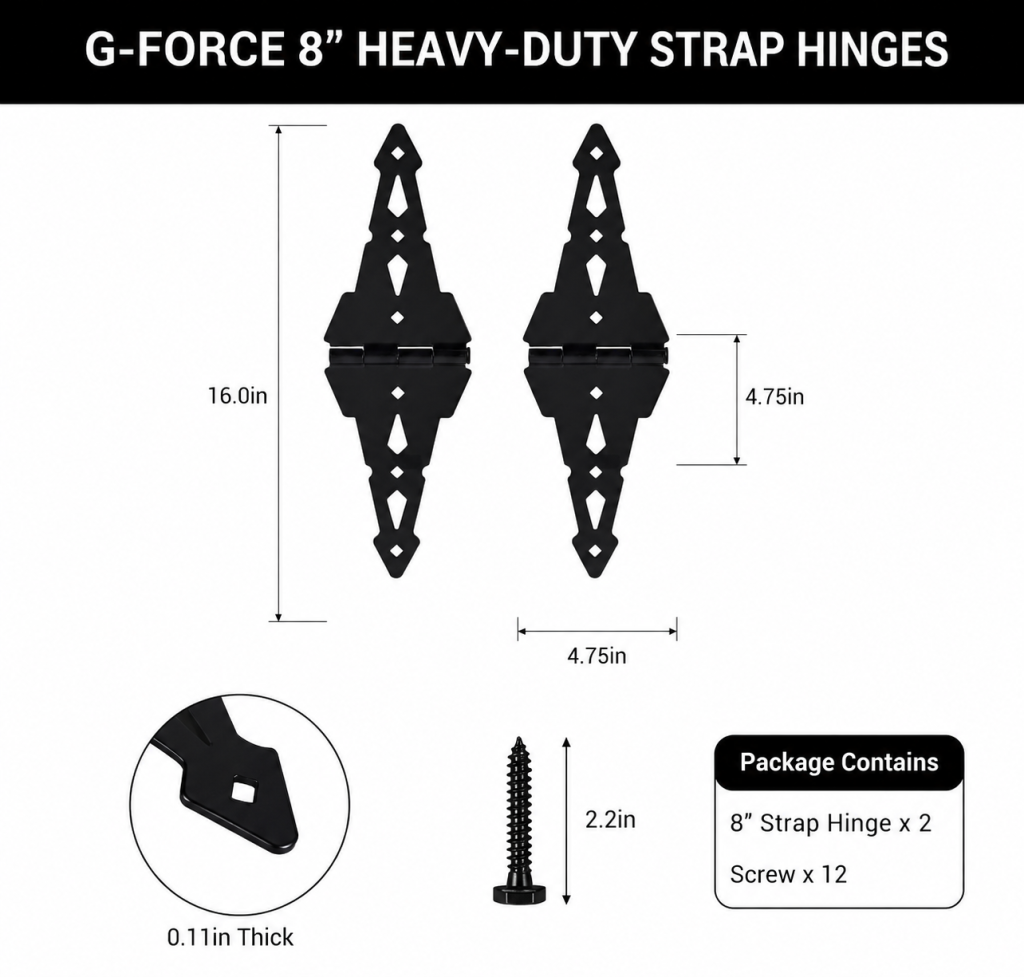
Strap hinges are commonly used on wood gates that swing outward and where there is enough mounting surface for both sides of the hinge to be fully secured. Unlike a T-hinge, a traditional strap hinge has long mounting straps on both sides of the hinge pin. For example, a 16-inch strap hinge typically requires approximately 8 inches of mounting space on the hinge post and another 8 inches along the gate rail. When that space is available and an outward-swinging gate is desired, a strap hinge provides a simple and practical way to attach the gate directly to the post.
Heavy-Duty Gate Hinges

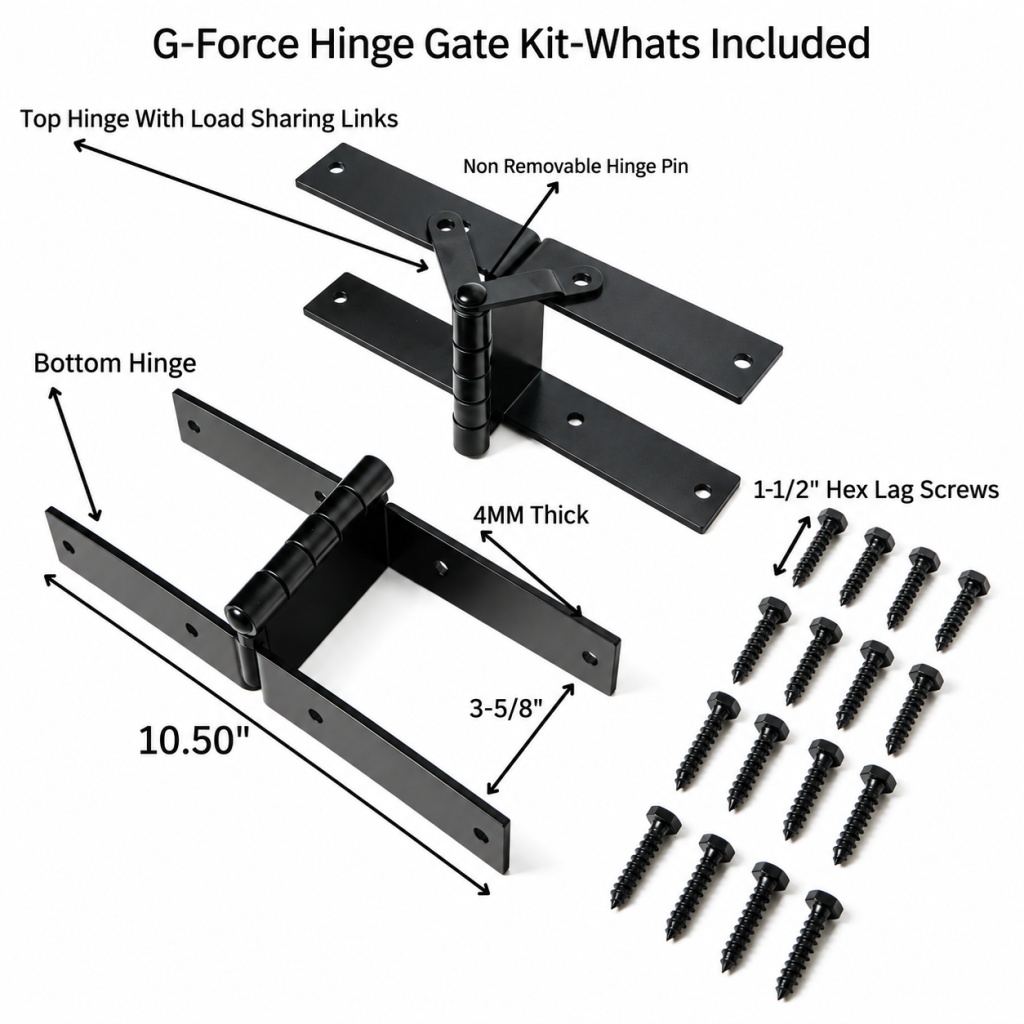
Heavy-duty gate hinges are designed for larger, heavier, or frequently used wood gates where conventional T-hinges or strap hinges may not be the best choice. The design of the hinge, how it attaches to the gate and post, the strength of the fasteners, and how the gate’s weight is transferred to the hinge post all affect long-term performance. Specialized hinge designs such as the G-Force Hinge and Infinity Hinge provide additional options for wood gates where strength, stability, and gate construction are important considerations.
Gate Latches & Locks
Choosing the right gate latch depends on how the gate is constructed, where the latch can be mounted, and whether the gate needs to be locked. Two of the most common designs used on wood gates are surface-mounted latches and post-mounted latches. Although both secure a gate in the closed position, the location of the latch mechanism and striker can affect installation, operation, and where a padlock or other locking device can be used.
Surface-Mounted Gate Latches
Surface-mounted gate latches are installed on the face of the gate and latch post. The striker bar is typically mounted to the face of the gate, while the latching mechanism is mounted to the face of the latch post. This straightforward design works well when both mounting surfaces are accessible and properly aligned. Surface-mounted latches are generally used to secure the gate in the closed position, but if the gate also needs to be locked, a separate hasp, barrel bolt, or similar locking device can be installed on the interior side of the gate.
Post-Mounted Gate Latches
Post-mounted gate latches attach to the side of the latch post rather than to its front face. The striker bar is mounted to the face of the gate and engages the latch mechanism as the gate closes. This mounting arrangement can be useful when the gate and post configuration makes a face-mounted latch less practical. Many post-mounted latches also include openings that align when the gate is closed, allowing a padlock or combination lock to be installed from the outside. On a single gate, however, the latch post can prevent access to those locking points from the interior side, so an additional hasp, barrel bolt, or similar device may be needed when the gate must be locked from inside.
Gate Wheels & Support
As a wood gate gets wider, the leverage it places on the hinges and hinge post increases substantially. Think of holding a bucket of water close to your side compared with extending that same bucket outward at arm’s length. The bucket has not become heavier, but the farther it is extended, the more difficult it becomes to support. A gate creates a similar effect: as its width increases and its weight extends farther from the hinge post, the downward force created by leverage becomes increasingly important.
Gate Wheels for Wider Gates
A gate wheel can greatly reduce the effect of this leverage by supporting the leading edge of the gate. Once properly installed, the wheel carries much of the gate’s weight at the point farthest from the hinge post. This substantially reduces the downward load being transferred through the hinges. In a traditional two-hinge installation, the lower hinge normally carries much of the gate’s weight while the upper hinge helps control and guide the gate. With a properly supporting gate wheel, both hinges function much more as guides while the wheel carries much of the vertical load. For this reason, gate wheels are commonly considered as wood gates become wider, particularly around five feet and beyond.
Supporting a Gate When It Is Closed
Proper support is also important when a gate is closed. On a single gate, an anti-sag latch can provide this support when the striker bar attached to the gate rests securely inside the latch mounted to a solid latch post. This gives the leading edge of the gate a fixed point of support while the gate is not being used. A double gate presents a different problem because there is no permanent latch post in the center. Simply securing one gate with a cane bolt or drop rod does not provide the same rigid structural support as a post. When the second gate latches to that unsupported gate, the center of the double gate can still move and settle under load. A removable center-post system provides a solid center support for the gates when closed while still allowing the full opening to be cleared when needed.
Hardware for Double Wood Gates
A double wood gate requires a different hardware plan because two moving gates meet in the center without a permanent latch post between them. Each gate needs its own hinges, while the center of the opening requires hardware to align, secure, and support the two gates when they are closed. Gate width and weight should also be considered when deciding whether either gate needs additional support such as a gate wheel. The proper combination of hinges, center support, and latching hardware helps the two gates operate together while still allowing the entire opening to be cleared when both gates are open. For a step-by-step construction guide, see How to Build a Double Wood Gate.
Securing and Supporting Double Gates
Double gates need a way to secure both gates at the center while still allowing the full opening to be used when necessary. One gate is commonly treated as the stationary gate and secured at the center, while the second gate closes and latches against it. Drop rods and cane bolts can hold the stationary gate in position, but they do not provide the same rigid support as a permanent latch post. For wider or heavier double gates, center support becomes increasingly important because both gates place load toward an opening where no permanent post exists. A removable center-post system can provide that support while allowing the post to be removed when the entire gate opening is needed.
Choosing Hinges and Wheels for Double Gates
The size and weight of each gate should determine the type of hinges and support needed for a double-gate installation. For smaller wood gates approximately 3 to 4 feet wide and 3 to 6 feet tall, good-quality strap hinges or T-hinges are generally suitable when properly installed. As gate width increases beyond approximately 4 feet—particularly on gates approaching 6 to 8 feet in height—heavy-duty hinges become increasingly important because of the additional weight and leverage placed on the hinge system.
Support at the leading edge is equally important. A single gate normally receives support when closed from its latch post and properly installed latching system. A double gate has no permanent center latch post, so even relatively small double gates benefit from a solid center-support system, such as a removable 4×4 center post. For small, lightweight garden-style double gates approximately 3 to 4 feet wide and 3 to 4 feet tall, a properly installed cane bolt or drop rod may provide adequate positioning and support. Larger and heavier double gates generally require a more substantial center-support solution.
Gate Handles and Pulls
A good gate handle or pull should provide a strong, comfortable grip while standing up to repeated use and outdoor exposure. Gate pulls are available in different sizes, shapes, materials, and finishes, ranging from simple utility handles to more decorative designs that complement the appearance of the gate and surrounding fence. For outdoor wood gates, look for a sturdy handle with enough clearance for a comfortable grip, corrosion-resistant construction or a weather-resistant finish, and mounting hardware substantial enough for the size and weight of the gate. Larger handles can be particularly useful on heavier gates because they provide an easier gripping surface when pulling the gate closed. The handle should be mounted securely near the latch side of the gate where it is convenient to reach without interfering with the latch or locking hardware.
Gate Fasteners and Mounting Hardware
Choosing the correct fastener is particularly important when building a gate with pressure-treated lumber because the preservatives used to protect the wood can accelerate corrosion of incompatible metals. Hot-dip galvanized and stainless-steel fasteners are commonly recommended for pressure-treated lumber, and some manufacturers offer specially coated exterior fasteners that are specifically approved for treated wood. Always check the fastener manufacturer’s specifications to confirm compatibility with the type of lumber being used. Avoid ordinary lightly zinc-plated or electroplated fasteners for long-term outdoor fence construction, where inadequate corrosion protection can eventually lead to rust, weakened fasteners, and unsightly rust stains running down the face of the fence boards.
Fastener length is just as important as corrosion resistance. A typical 5/8-inch fence board fastened to a 1½-inch-thick 2×4 rail provides approximately 2⅛ inches of total wood thickness. A nail or screw should not be so long that its point passes completely through the rail and remains exposed on the opposite side of the gate. Exposed fastener points can create a serious injury hazard. Choose a fastener that provides adequate penetration into the supporting rail without exceeding the combined thickness of the materials being fastened.
Nails vs. Screws for Wood Fences and Gates
Both nails and screws can be used successfully when building wood fences and gates, but the type of lumber and the job the fastener is performing should be considered. Pressure-treated lumber is often installed while it still contains considerable moisture and will typically shrink as it dries. For attaching pressure-treated fence boards, properly selected exterior-rated nails—particularly ring-shank nails—can provide a strong, economical connection and allow a contractor to install boards much faster than with screws. Screws may be preferred where greater withdrawal resistance, easier future removal, or a more controlled connection is desired. With untreated or naturally durable lumber that may repeatedly absorb and release moisture outdoors, screws can also be a good choice where movement of the boards could gradually work conventional nails loose. Regardless of whether nails or screws are used, the fastener must be rated for exterior exposure and compatible with the lumber, and its length should be chosen so the point cannot protrude dangerously through the opposite side of the gate or fence.
Gate Bolts, Drop Rods & Cane Bolts
Cane bolts and drop rods are commonly used to hold one side of a double gate stationary when there is no permanent center latch post. A traditional cane bolt slides vertically through guides or screw eyes attached to the stationary gate and drops into a receiver in the ground. A short section of PVC pipe or metal tubing installed in the ground is often used as the receiver, providing a consistent opening for the bolt. Drop rods perform essentially the same function but usually include their own mounting brackets or guides that attach directly to the vertical gate frame. In either case, the purpose is to hold one gate in position so the second gate can close and latch against it.
Cane bolts and drop rods are best suited to relatively small, lightweight double gates and should not be considered a substitute for substantial center support on larger wood gates. Based on our experience, they can be a practical solution for garden-style double gates with individual gate sections approximately 3 to 4 feet wide and no more than about 3 to 4 feet tall. As the gates become wider, taller, and heavier, the amount of leverage and movement at the unsupported center increases substantially. For larger double wood gates, we recommend a solid center-support system rather than relying on a cane bolt or drop rod alone to make one gate stationary.
Gate Braces & Anti-Sag Hardware
Wood gates should be supported rather than simply pulled back into position with tension. Cable-and-turnbuckle kits are commonly marketed as anti-sag hardware, but tightening a cable between opposite corners of a wood gate applies tension within the gate itself. The cable does not transfer the gate’s weight to the hinge post or another fixed support. Excessive tension can also distort the gate frame, and wood that repeatedly absorbs moisture and dries can continue to move after the cable has been tightened.
The diagonal brace is one of the most important structural components of a properly built wood gate. A gate may be constructed from numerous individual pieces—including fence boards, top and bottom rails, vertical framing members, and the diagonal brace—but once those components are securely fastened together, they must function as a single structure. Without the diagonal brace, gravity acting on the unsupported leading edge of the gate can cause the rectangular frame to rack, allowing the top rail, bottom rail, and vertical framing members to move out of square even though they are fastened together. A properly installed diagonal brace runs from the lower hinge side of the gate upward toward the leading or latch side. As gravity tries to pull the leading edge downward, the brace works primarily in compression, transferring that load diagonally through the gate structure toward the lower hinge area and ultimately back to the hinge post. In this way, the diagonal brace helps keep the individual components working together as one rigid gate rather than allowing the frame to gradually collapse out of square.
The other important source of support is at the leading edge of the gate. A single gate can receive support when closed from a solid latch post and a properly designed supporting latch system. A double gate has no permanent center latch post, which is why larger double gates benefit from a solid removable center post or similar structural support. Gate wheels can provide additional support while a wider gate is moving. The goal is the same in each case: support the weight of the wood gate and transfer that load to a solid supporting point rather than relying on tension within the gate to hold it in position.
Gate Hardware for Wood Gates That Last
A long-lasting wood gate depends on more than any single piece of hardware. The gate must be built as a complete structural system, with properly sized hinges, a correctly installed diagonal brace, suitable exterior fasteners, and adequate support for the gate’s width and weight. The hinge post provides the foundation for the gate, while the hinges, framing, brace, latch, and any additional support work together to control the forces created by the gate’s weight and leverage. Taking the time to select and install each component correctly can help a wood gate remain square, operate smoothly, and provide years of reliable service.
Explore Gate Hardware for Wood Gates & Installation Guides
Use the resources below to learn more about choosing, installing, and supporting hardware for wood gates, or browse the gate hardware available for your project.